
The Friday Five (7.10.26)
A Few Things for My Friends


Every week, I share five things to encourage and equip in life with God.
In late June, we took our oldest to NYC for her birthday. We’re hoping when each kid turns 13, we can take them on a city visit of their choice. So for three days, we hit every sweet treat and saved pin on the map. We spent an afternoon at The Met, and it was overwhelming. In my twenties, I had a student pass to The Louvre, and would pop in for an afternoon just to see a certain wing, trying to take it a piece at a time. No such luck this day - so we hit four exhibits and saved the rest for another trip.
In previous weeks, I have highlighted The Visual Commentary on Scripture, a resource from King’s College London. Many of us need to see things to learn it, to image it with our eyes and place ourselves in the story. I spend most of my days in words and conversations, and was grateful for hours in front of paintings to be washed by brushstrokes that spoke to different parts of my heart.
This week, I’m sharing art I’ve come across that has stayed with me. I hope you take time to sit with them and be engaged at a deeper level than a cursory glance. It amazed me when I read that Henri Nouwen flew to St. Petersburg so he could sit in front of Rembrandt’s Return of the Prodigal Son. I thought of him sitting for hours, taking in the details and shadows of the story in the hands of a Dutch Master. He was changed. You never know what might happen, be careful out there.
This week:
The Tears of Peter
Agnus Dei
The Healing of a Fever
The Prodigal Son
The Harrowing of Hell
Enjoy,
MK
⬇️ Check out my book on Spiritual Disciplines! ⬇️

Read the forward from Jen Wilkin | Grab a copy here | Here’s a Discussion Guide
1. The Tears of St. Peter
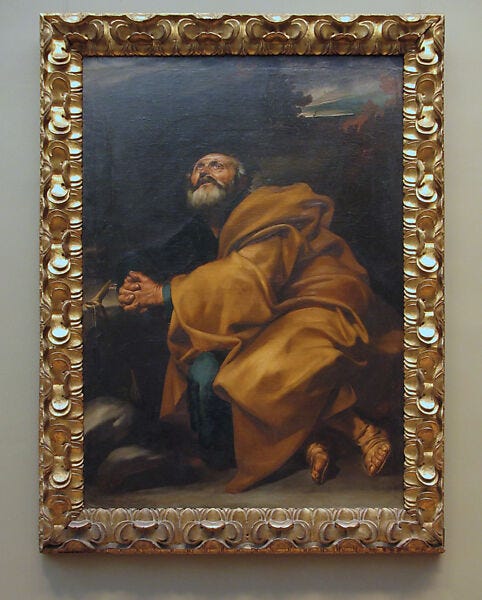
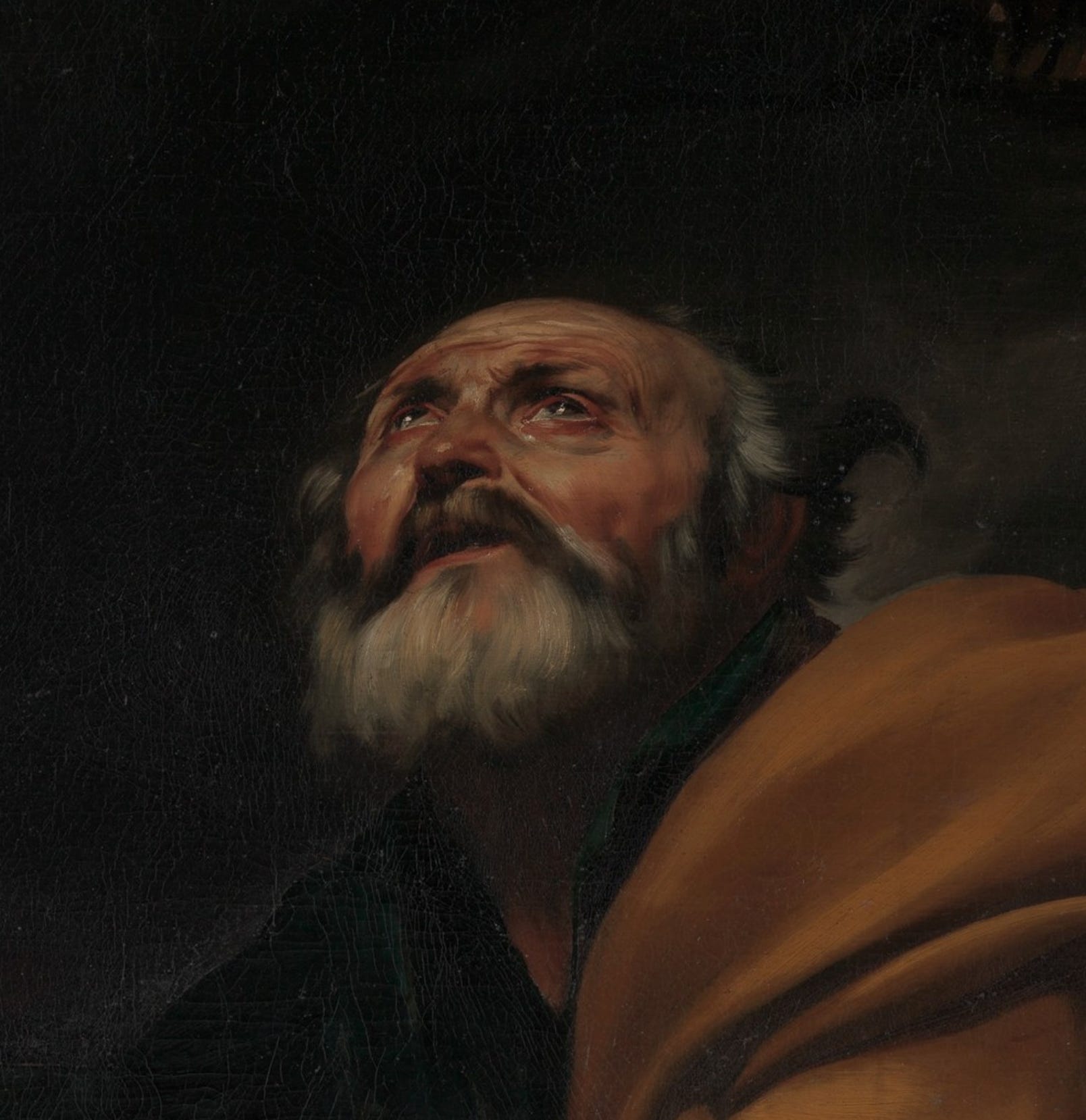
This stopped me in my tracks. The contrast of colors in Peter’s robes, his posture, his expression. I read the placard:
This early work by Ribera, who was Spanish by birth but spent his career in Italy, is first mentioned in Rome in 1644 in the collection of Cardinal Benedetto Monaldi Baldeschi. The painting shows Saint Peter after he has denied Christ, his eyes red with tears and his hands clasped in prayer. The figure’s pose embodies the crushing weight of his sin. Seen as a form of confession, such dramatic shedding of tears became central to Catholic devotional practices and was praised in poetry and song.1
Then I couldn’t stop looking at his eyes, and the tears. What guilt and grief, what pain and pressure Peter feels in his moment of denial and need. You can feel his heartache.
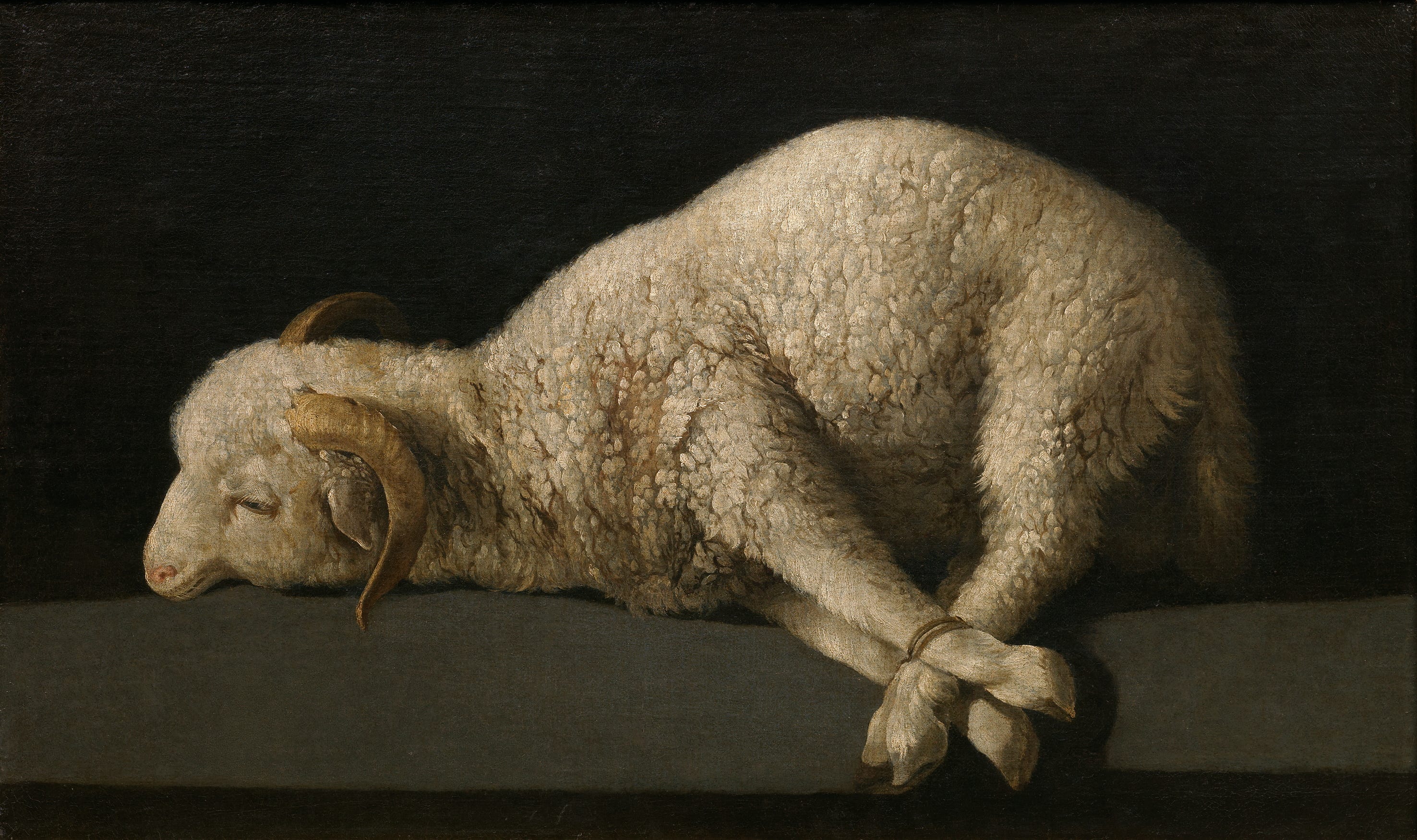
2. Agnus Dei
A few years ago, I opened the door to my office to find a postcard of a painting left by one of our missionaries from Spain. It was of a painting from The Prado Museum, entitled Agnus Dei. The postcard is on my office wall, a reminder of these friends and of the Lamb himself. I turned a corner in The Met and came face to face with the original which is currently on loan.
Here’s the description:
Francisco de Zurbarán transformed what first appears to be a simple still life into a powerful symbol of religious devotion. An innocent lamb tied in preparation for sacrifice represents the body of Christ, described in the Gospel of John as the “Lamb of God” who died in order to “take away the sins of the World.” Early collectors, however, equally appreciated Zurbarán’s realism, as indicated by the account of “an art lover in Seville who has a lamb by this maker’s hand, painted from life, which he values more than one hundred living rams.” Zurbarán’s innovative treatment of this subject proved successful, and multiple versions are known from the 1630s.2
3. The Healing of a Fever
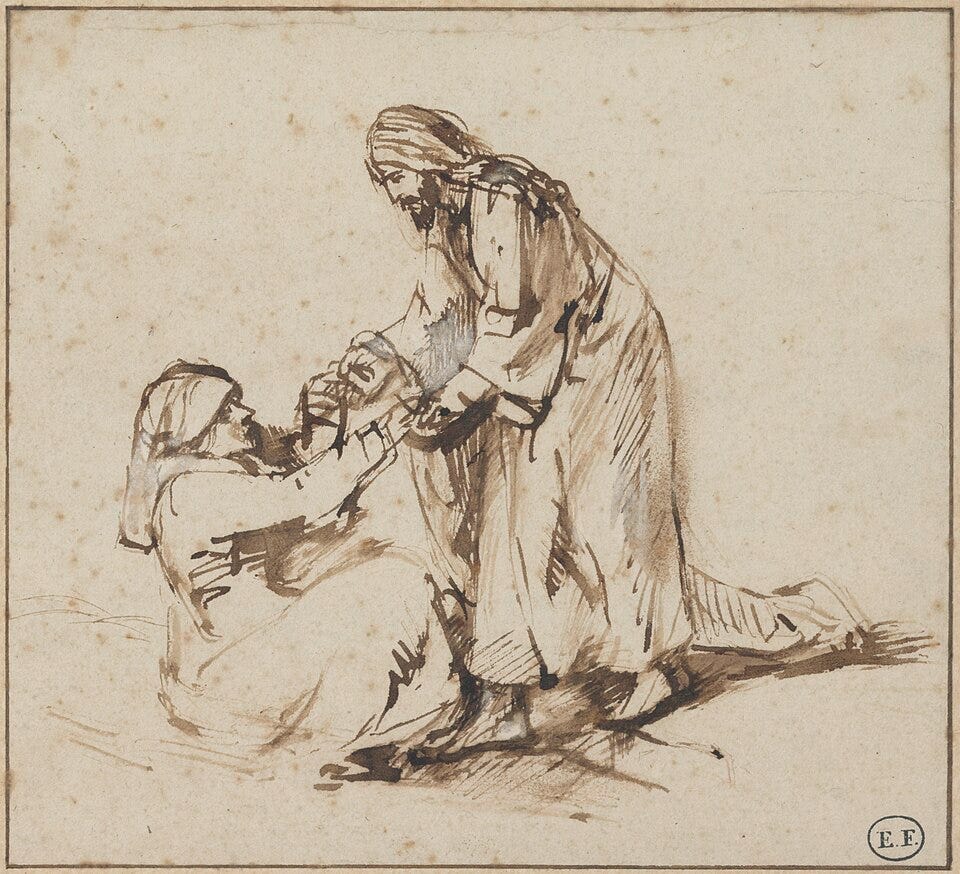
Last year, I taught through Luke in our Men’s Bible Study. In Luke 4, Jesus heals Peter’s Mother in Law, and as her fever leaves her, she gets up and starts to serve dinner. I know when I have a fever, even when it breaks, I’m good to stay in bed and rest a bit - but she can’t help but respond to what’s happened!
Rembrandt is among my favorites, especially his sketches and etchings. Here’s a partial commentary on this piece from the VCS:
Here Rembrandt depicts the crucial moment from Mark’s account where Jesus takes the hand of Peter’s mother-in-law and helps her to her feet—thus effecting a miraculous cure by touch (as specified in Mark’s account). It is a strikingly intimate portrayal of the scene, which is rarely represented in art of any medium. This approach, in which extraneous supporting characters are stripped back so as to focus fully on the story’s protagonists, is characteristic of Rembrandt’s treatment of biblical scenes—subject matter often used in teaching works for pupils (Schatborn 2010: 85).
This is also a scene of action—the figures are in motion, and the cure that Christ is effecting is in process. Christ steps down with his right foot, as he bends towards Peter’s mother-in-law. The two exchange glances. With a few expertly judged strokes of the pen, Rembrandt implies the clenched jaw of Peter’s mother-in-law as the fever leaves her and she uncertainly attempts to stand, as well as the calm, downturned countenance of the healing Christ. Similarly, a few lines are all that’s needed to indicate the two pairs of hands clasped together, or the mattress from which Peter’s mother-in-law rises—none of which is fully drawn.3
If you are interested in looking at more of Rembrandt’s biblical work, you can look at this free PDF of a book entitled, Rembrandt and The Bible.
4. The Prodigal Son
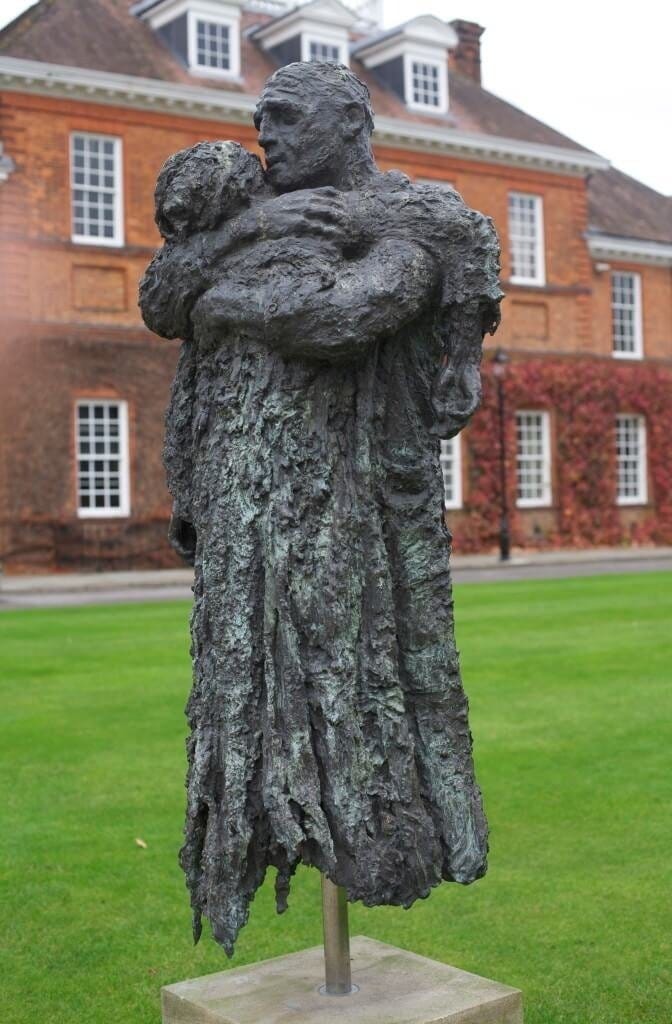
Decades ago, while attending Holy Trinity Brompton, I met Charlie Mackesy, most recently known for his work, The Boy, the Mole, the Fox and the Horse. On the road in London, you can find one of his sculptures, which is of the moment in Luke 15 where the Prodigal Son returns and is embraced by the Father.
I can’t get over the texture, the utter dependence of the son, the loving grasp of the Father. I also really like this version of it as well.
5. The Harrowing of Hell
This piece has made it into a Friday Five before, and for good reason. It’s The Anastasis, a painting from a chapel in Turkey from the 1300’s.
In it,
Christ, trampling Satan and all the locks and keys of his prison house of Hell, raises Adam and Eve from their tombs. Looking on are John the Baptist, King David, and King Doloon on the left, and various martyr saints on the right. Christ, central and in a luminous mandorla, reaches out equally to Adam and Eve. The action is swift and smooth, the supple motions executed with the grace of a ballet. The figures float in a spiritual atmosphere, spaceless and without material mass or shadow-casting volume. This same smoothness and lightness can be seen in the modeling of the figures and the subtly nuanced coloration. The jagged abstractions of drapery found in many earlier Byzantine frescoes and mosaics are gone in a return to the fluid delineation of drapery characteristic of the long tradition of classical illusionism.Through the centuries, Byzantine artists looked back to Greco-Roman illusionism. But unlike classical artists, Byzantine painters and mosaicists were not concerned with the systematic observation of material nature as the source of their representations of the eternal. They drew their images from a persistent and conventionalized vision of a spiritual world insusceptible to change.4
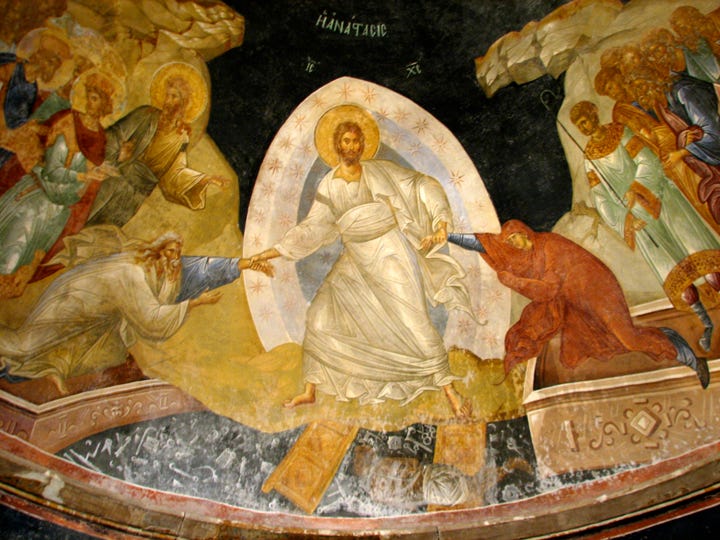
Lots to take in. Give it a minute. This painting is a culmination point of the Biblical reality in Christ!
If you have a piece that you love, that has shaped you, or expanded your understanding of the Biblical text, I’d love to know! Drop it in the comments, I’ll be sure to check it out.
Thanks for Reading
If someone forwarded this to you, I write two kinds of emails: one on select Tuesdays about life with God and the other every Friday, where I share things I’ve found during the week. If you want to subscribe but can’t afford it, email me, and I’ll take care of it—no questions asked.
I pastor, teach, and lead at The Village Church, serving as an Elder and the Executive Director of Discipleship. I’m also working on a Ph.D. in Church History, studying Jonathan Edwards and character formation. I’ve written A Short Guide to Spiritual Disciplines: How to Become a Healthy Christian.
Thank you for reading and supporting my work as I seek to shepherd with compassion and wisdom, equipping people to embody God’s truth for all of life.
Talk soon,
Mason
https://www.metmuseum.org/art/collection/search/441971
https://www.metmuseum.org/art/collection/search/857034
https://thevcs.org/peters-mother-law
https://diglib.library.vanderbilt.edu/act-imagelink.pl?RC=54562
What a moving post! Thank you for walking us through those beautiful pieces.