
The Friday Five (7.31.26)
A Few Things for My Friends


Hey!
Every week, I share five things to encourage and equip in life with God.
This week:
1. How Do We Become Who God Wants Us to Be?
2. Logos Study Assistant
3. Plain Christianity | J.B. Phillips
4. God’s Homecoming | Michael F. Bird
5. Thinking About Heaven | Matt Pitts
Enjoy!
MK
⬇️ Check out my book on who you’re becoming and how to grow in Christ! ⬇️

Read the forward from Jen Wilkin | Grab a copy here | Here’s a Discussion Guide
1. How Do We Become Who God Wants Us to Be?
This week, I preached on a question I’ve been circling for decades in ministry:
How do we become who God wants us to be?
It’s the question underneath a lot of my work and writing, calling believers to put off the old way of life and live into God’s good design through Christ.
This sermon covers 2 Peter 1:3-11, one of my favorite passages in the epistles - and my wife said it might be her favorite sermon I’ve ever preached - so give it a go and I hope it serves you!
Everything required for life and godliness has been given to us in Christ, therefore the work of our life is to grow into who He’s designed us to be, and to gather those who need to see Jesus.
2. Logos Study Assistant
I’ve been a Logos user for the last decade, and these days the way I’m using it has dramatically changed due to a new feature, the Study Assistant. It’s an AI agent built into the platform - but it’s limited to your library (or the larger Logos library), it doesn’t hallucinate (make up answers and fake sources) and isn’t looking to build a model based on your preferences. It’s answering your questions based on vetted theological sources, and you can have a conversation with it.
Bottom line: If you’re going to ask Chat or Claude a theological question, don’t. Ask Logos Study Assistant. Your results are sourced, you can double click into the context immediately, and you can dig in wherever you want to from questions like: “How should I think about the Trinity and the Old Testament” to today where I asked it to “source all the sermons in which Jonathan Edwards used a metaphor about light.”
Simpler still: What does the Bible say about anxiety? Here’s the response for that one:
The Bible addresses anxiety through multiple themes: the command to release worry, the promise of God’s presence and care, and the pathway to peace through faith and prayer.
Jesus directly confronts anxiety in his teaching. He instructs his followers not to worry about life’s necessities—food, drink, and clothing—and points out that anxiety cannot extend one’s lifespan (Matt 6:25–34). Rather than dwelling on material concerns, Jesus calls people to prioritize God’s kingdom and righteousness, assuring them that their needs will be provided (Matt 6:25–34). He counsels against worrying about tomorrow, noting that each day contains sufficient challenges of its own (Matt 6:25–34).
The apostle Paul offers a practical remedy: instead of worrying, believers should present their requests to God through prayer and petition with gratitude, and God’s peace—which surpasses understanding—will guard their hearts and minds in Christ (Phil 4:6–7). Peter similarly encourages casting all cares on God, because he cares for his people (1 Pet 5:7).
Throughout Scripture, reassurance replaces anxiety. Paul reminds Timothy that God has not given a spirit of fear, but of power, love, and sound judgment (2 Tim 1:7). Perfect love drives out fear (1 John 4:18), and God keeps in perfect peace those whose minds depend on him and trust in him (Isa 26:3). God promises strength and help, holding believers with his righteous hand (Isa 41:10).
It’s important to note that Scripture distinguishes between different types of worry—legitimate concern for others’ welfare and appropriate care for responsibilities are presented as distinct from the anxious preoccupation with material security that Jesus warns against[1]. Worry itself is not sinful but part of the human condition, and how people respond to life events is deeply connected to their worldview and lifestyle choices[2].
Additional biblical passages on anxiety: The psalmist testifies that seeking the Lord brings rescue from all fears (Ps 34:4), while God is described as a refuge and strength, always available in times of trouble (Ps 46:1–3). Jesus offers his peace as a gift, distinct from worldly peace, and commands his followers not to let their hearts be troubled or fearful (John 14:27).
[1] Gregory R. Lanier, Luke, ed. Brandon D. Smith and Andrew M. King, Christian Standard Commentary (Holman Reference, 2025), 624.
[2] Barrett W. McRay, Mark A. Yarhouse, and Richard E. Butman, Modern Psychopathologies: A Comprehensive Christian Appraisal (Downers Grove, IL: IVP Academic: An Imprint of InterVarsity Press, 2016), 186.
My friend, Nick Stapleton, did a video over this feature that you can watch below.
Logos is a subscription model now, and you get a ton of resources for the price of a couple fancy coffees a month. Check it out. (I get nothing for telling you about this, except the hope you don’t ask a bad AI questions about what you can’t afford to get wrong!)
3. Plain Christianity
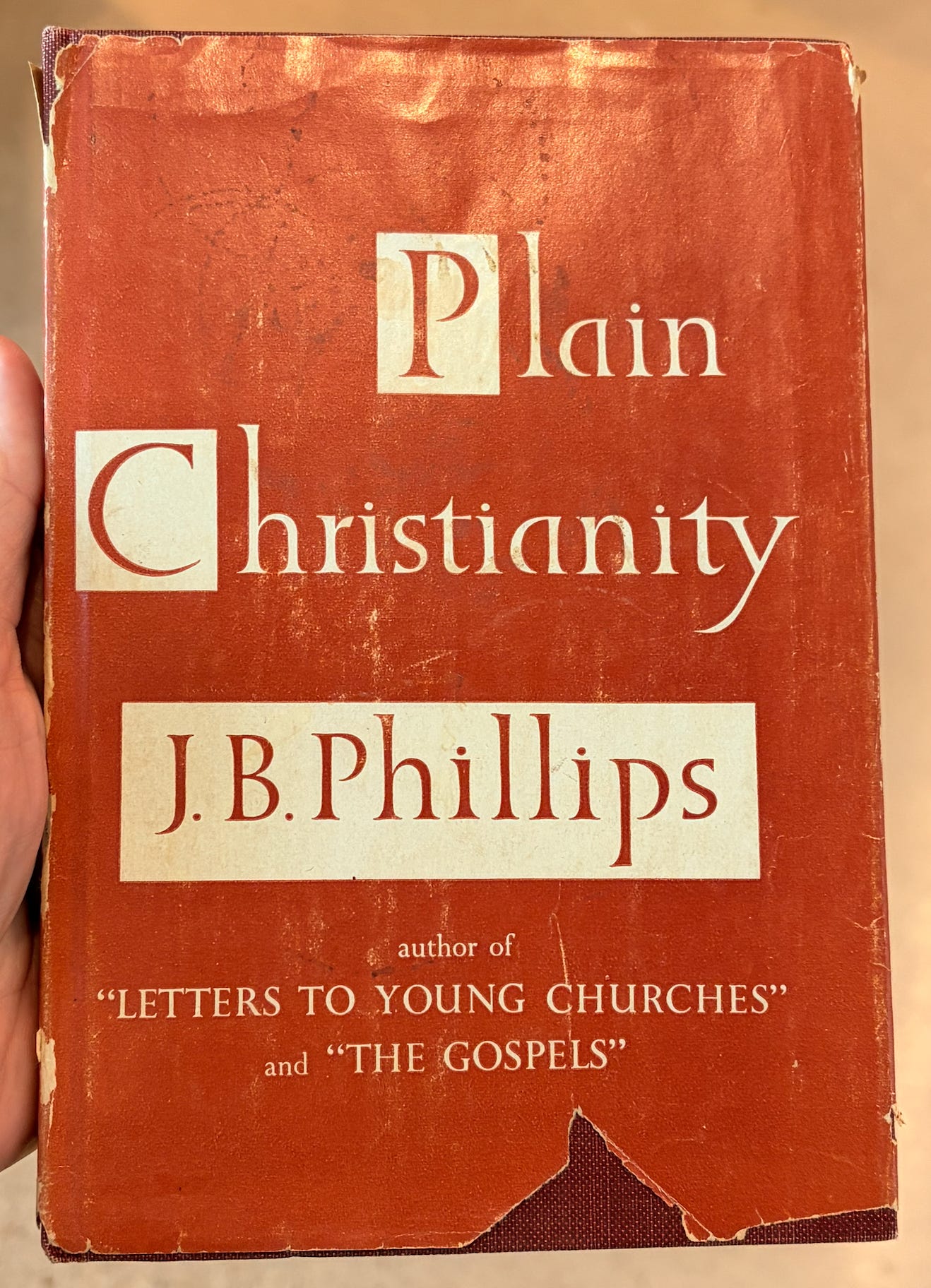
Last week, I shared how I’ve been enjoying J.B. Philips’ translation of the New Testament. This week, I got a copy of Plain Christianity & Other Broadcast Talks in the mail, a 1954 series of radio broadcast talks given by Philips on the BBC.
If that sounds a lot like another series BBC broadcasts on faith with a two word title that shaped a generation, you’re not wrong. What became Lewis’ Mere Christianity were talks broadcast in 1942-44, then published in 1952.
For years, I’ve always tried to go upstream of my favorites. I look for the ones who influenced my heroes and try to see what they passed down that shaped who (and what) I admire. I’ve done it with Edwards, Roosevelt, Lewis, Willard, and many more. It’s led me to some great new (old) friends across the years. I realized this week, Philips had Lewis as a patron who supported and encouraged his work. What a fun thing to see.
Plain Christianity is a short work, only 87 pages, and I’m looking forward to reading his simple style explain what distinguishes believers from unbelievers in the world.
What are you reading this week? Drop it in the comments and let’s see what everyone is into!
4. God’s Homecoming
Michael F. Bird has a short piece covering N.T. Wright’s new work, God’s Homecoming: The Forgotten Promise of Future Renewal. Bird calls it vintage Wright, and includes a video from his podcast about the book.
I remember reading Surprised by Hope right after college, and it blew my mind to think about what the Bible said about Heaven and how we will exist in the New Creation. Twenty years later and I can tell you it re-shaped the way I understood things.
Bird Says:
Wright contends that the popular Christian assumption that life after death is disembodied, immortal bliss in heaven, dangerously implies that God created a world he loves only to abandon it. The real scriptural story, he insists, runs in precisely the opposite direction. The master narrative of the Bible, in Wright’s terms, is that God is coming to visit us, not us going up to heaven, but God coming down to earth, climaxing in the marriage of the heaven and earth in the new creation.
Read the rest here. I’m eager to dig into the book!
Check out Bird’s podcast on the book below:
5. Thinking about Heaven
I texted my college roommate yesterday morning and said, “I’m so glad the world created something like Substack so that I could get more Matt Pitts in my daily life.” Matt is the pastor of Minden Baptist Church, and a professor of Bible and Philosophy at Jacksonville College. His substack notes are a litany of book covers and quotes - and I enjoyed this piece about a single quote from Augustine that inspired an entire book.
Matt quoting Mascall quoting Augustine:
This is a book for Christians who are still upon earth, but I have based it upon a sentence in which S. Augustine describes our future life in heaven: ‘There we shall rest and we shall see; we shall see and we shall love; we shall love and we shall praise. Behold what shall be in the end shall not end.’ (pg 1)
Read how Pitts unpacks this sentence and points toward our great hope.
Thanks for Reading

If someone forwarded this to you, I write two kinds of emails: one on select Tuesdays about life with God and the other every Friday, where I share things I’ve found during the week. If you want to subscribe but can’t afford it, email me, and I’ll take care of it—no questions asked.
I pastor, teach, and lead at The Village Church, serving as an Elder and the Executive Director of Discipleship. I’m also working on a Ph.D. in Church History, studying Jonathan Edwards and character formation. I’ve written A Short Guide to Spiritual Disciplines: How to Become a Healthy Christian.
Thank you for reading and supporting my work as I seek to shepherd with compassion and wisdom, equipping people to embody God’s truth for all of life.
Talk soon,
Mason