
The Friday Five (2.27.26)
A Few Things for My Friends


Hey!
Every week, I share five things to encourage and equip in daily life with God.
This week:
Thomas Boston’s Personal Covenant
The Blind Beggar
Emotional Intelligence / Story Work Resources
67 Sermons on 1 John
Dragging Theology Through The Mud
Enjoy,
MK
⬇️ Have you read about offering your attention, emotions, and limits to God? ⬇️

Read the forward and introduction | Grab a copy here | Here’s a Discussion Guide
1. Thomas Boston’s Personal Covenant
Found the following while studying Luke recently. Lewis talked about how relying on God had to begin all over again each day as if nothing had yet been done, and Boston’s renewal here was a variation on the theme in my mind. I resign myself, soul and body, to him, to be saved by his blood alone. The last few weeks I’ve been humming and singing the first verse of Fully Yours each morning, verbally offering all of me to Jesus. I like Boston’s prayer here: I give myself wholly unto him, to serve him for ever.
The great Scottish theologian Thomas Boston renewed his personal covenant with God near the end of his life and ministry. Boston went to his secret place for prayer and said:
O Lord, the God and Father of our Lord Jesus Christ, I confess from my heart, that I am by nature a lost sinner. I am fully convinced that I am utterly unable to help myself. But as there is a covenant of grace, I do now again take hold of that covenant, for life and salvation to me; believing on the name of Christ crucified, who made atonement, paid the ransom, and brought everlasting righteousness for poor sinners. I resign myself, soul and body, to him, to be saved by his blood alone. I give up myself wholly unto him, to serve him for ever.
Then, as Boston came to the end of his personal covenant, he called on the very walls of his house to witness the promise he was making to Jesus Christ:
Let it be recorded in heaven, O Lord, and let the bed on which I lean, the timber, and the stones, and all other things here in my closet, bear witness that I, though most unworthy, have this second day of December, here taken hold of, and come into thy covenant of grace, offered and exhibited to me in thy gospel, for time and eternity; and that thou art my God in the covenant, and I am one of thy people, from henceforth and for ever.1
2. The Blind Beggar
Also from Luke (and Ryken!), this week we ended talking about the blind beggar who received back his sight. He cried for mercy, and Jesus met him. I’ve been thinking a lot about how easy it is to move away from mercy, like growth in Christ means you move past your need for mercy. I’m so glad Jesus knows better than us, and that His mercy is greater than my foolishness.
In his book on the miracles of Jesus, Richard Phillips points out that the various miracles in Luke show us the deadly and disabling effects of sin: “Leprosy shows sin’s corrupting power and condemning presence. The lame show sin’s debilitating power. The dead proclaim the wages of sin; the demon-possessed show the destructive domination that is always the result of our bondage to sin and to Satan.”2 For each miracle, there is an analogy between the physical needs of the body and the spiritual needs of the sinful soul. What the beggar of Jericho shows us—by his disability and by his plea for mercy—is the blinding effect of sin. Without the work of the Holy Spirit, we fail to even see how sinful we are, or how much need we have for the grace of God.2
3. Emotional Intelligence / Story Work Resources
On Thursdays, I meet with a small group of men on zoom from across the world. It’s an emotional intelligence cohort, where we practice, share, and sit with each other through what is happening in life.
It’s one of the more challenging things I’ve done the last few years: talking about my feelings with guys I’ve never met in real life - and it’s changing how I show up to myself, my wife, kids, and congregation.
I didn’t want to go yesterday. I had lots of feelings I didn’t want to engage, which stood out to me as I started to make excuses in my head about how I needed to work instead. I went, and I’m glad.
It takes time, trust, and risk to build a container that can hold emotions and their messy owners. Too often we won’t risk sharing because we don’t want the shame of being rejected. I’ve found the opposite: that vulnerability helps others connect dots inside their own hearts.
I got a message yesterday asking what resources I’d recommend around this so I’m sharing them here - and just to double down on how important I think it is, my blue book is centered around three dimensions of life that we offer to God: our attention, emotions, and limits. Your emotions are primary filters for how you experience the world, and they are data about how your body is engaging the world in real time. Learning to steward them (rather than just shutting them down or being overrun by them) is important!
Here are some recommended starting points:
Chip Dodd - The Voice of the Heart
Steve Cuss - Managing Leadership Anxiety (book) and Capable Life (learning platform) and Being Human Podcast
Adam Young - Make Sense of Your Story (book) and The Place We Find Ourselves (podcast)
Aundi Kolber - Try Softer
Todd Hall - The Connected Life and Relational Spirituality
Curt Thompson: Being Known Podcast, The Soul of Shame (book)
4. 67 Sermons on 1 John
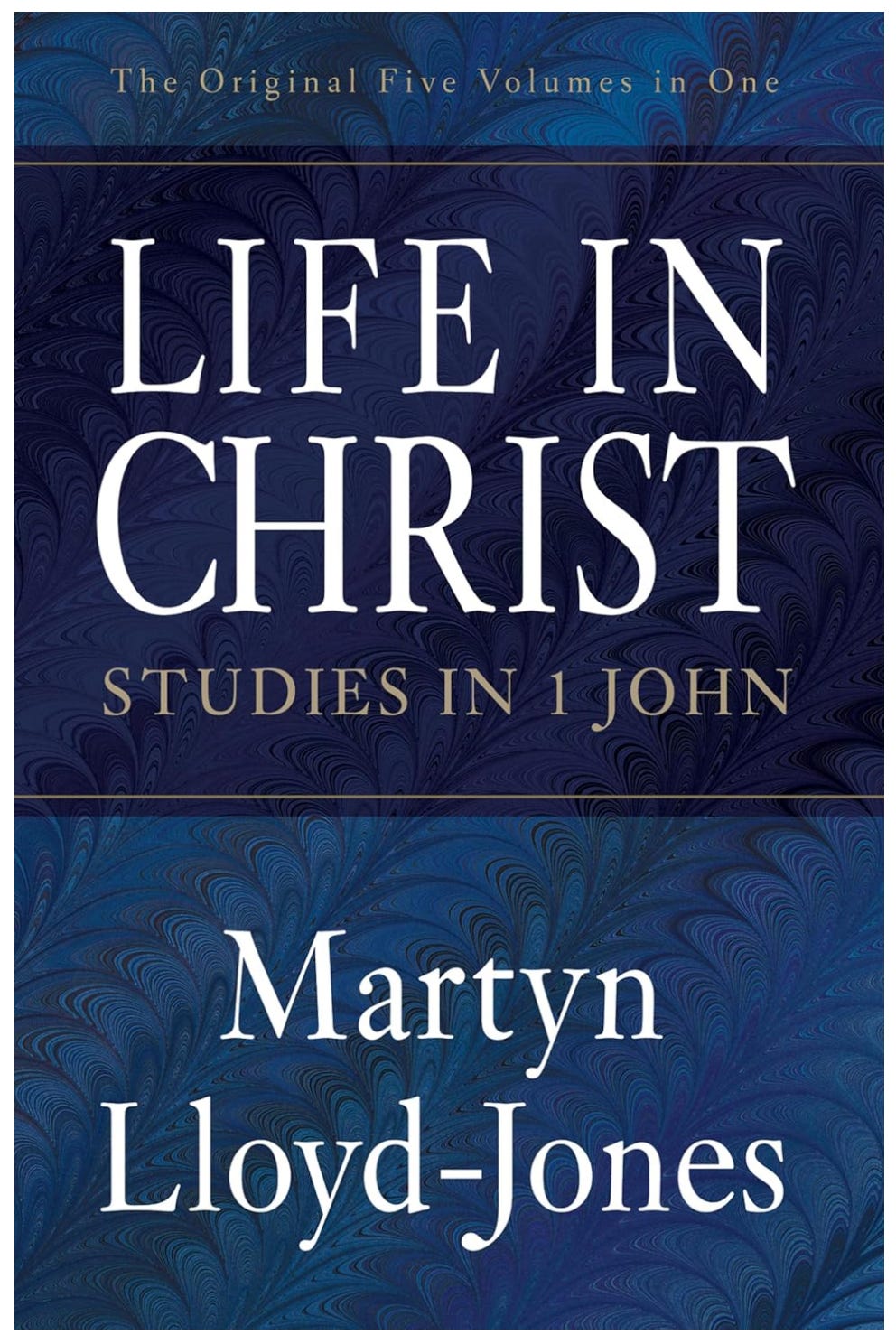
This week, I learned that Martyn Lloyd Jones preached 67 sermons on 1 John.
Sixty-seven.
This weekend I’m preaching over 1 John 5:1-12, and he wrote 8 for those twelve verses alone. They were a delight to read and get his insight on the text.
For under $30, you can get 67 sermons. That’s about 45 cents each, which is a feast to be had.
5. Dragging Theology Through the Mud
R. Michael Spangler of at Heart in Pilgrimage has written a poem entitled Earthy Theology, and you should go read it. It made me stop and consider, and that’s what poetry should do.
I don’t want to post it here, because you should go read it and subscribe to his newsletter so you can read more of his poetry: it points to Jesus.
Thanks for Reading
If someone forwarded this to you, I write two kinds of emails: one on select Tuesdays about life with God and the other every Friday, where I share things I’ve found during the week. If you want to subscribe but can’t afford it, email me, and I’ll take care of it—no questions asked.
I pastor, teach, and lead at The Village Church, serving as an Elder and the Executive Director of Discipleship. In my spare time (ha!), I’m working on a Ph.D. in Church History, studying Jonathan Edwards and character formation. Also, I’ve written A Short Guide to Spiritual Disciplines: How to Become a Healthy Christian.
Thank you for reading and supporting my work as I seek to shepherd with compassion and wisdom, equipping people to embody God’s truth for all of life.
Talk soon,
Mason
Abridged from the “Copy of His Personal Covenant” printed with Thomas Boston, Memoirs, in The Complete Works of Thomas Boston, Ettrick, 12 vols. (London, 1853; reprint Wheaton, IL: Richard Owen Roberts, 1980), 12:453–54.
Philip Graham Ryken, Luke, ed. Richard D. Phillips, Philip Graham Ryken, and Daniel M. Doriani, vol. 2, Reformed Expository Commentary (Phillipsburg, NJ: P&R Publishing, 2009), 284.
Richard D. Phillips, Mighty to Save: Discovering God’s Grace in the Miracles of Jesus (Phillipsburg, NJ: P&R, 2001), 207.
Philip Graham Ryken, Luke, ed. Richard D. Phillips, Philip Graham Ryken, and Daniel M. Doriani, vol. 2, Reformed Expository Commentary (Phillipsburg, NJ: P&R Publishing, 2009), 294.
Thank you, Mason! 🙌