
The Friday Five (4.10.26)
A Few Things for My Friends


Hey! Every week, I share five things to encourage and equip in life with God.
This week:
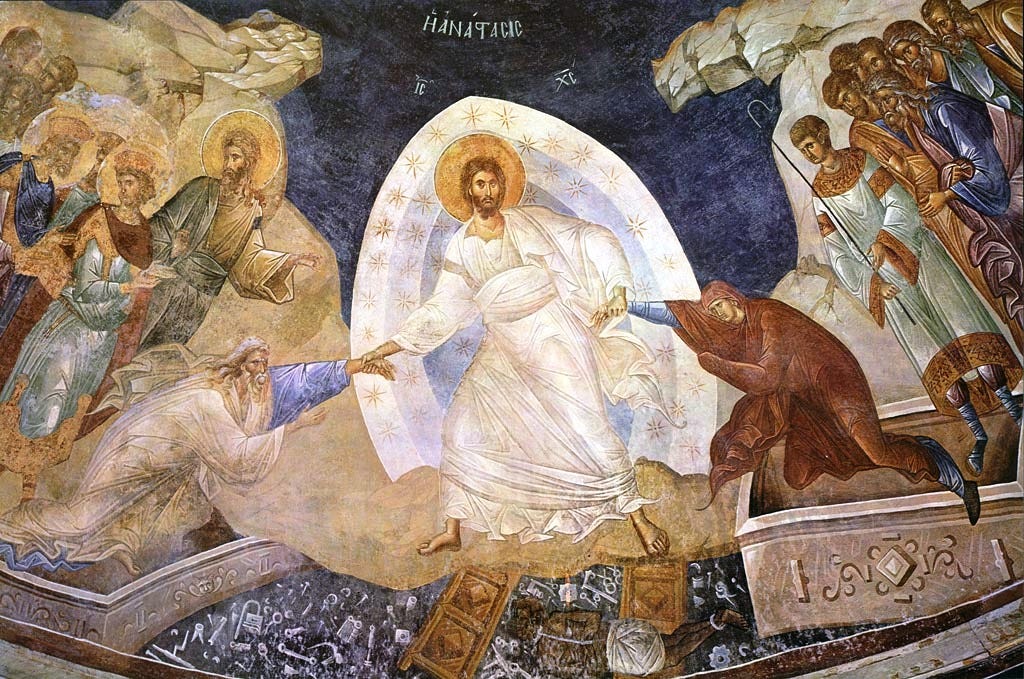
The Anastasis
The Gospel Way Catechism
Telling the Truth
Stop Treating Your Will as a Suggestion Box
Truth Bombs from David Powlison
Enjoy!
MK
⬇️ Have you read my book on spiritual disciplines? ⬇️

Read the forward and introduction | Grab a copy here | Here’s a Discussion Guide
1. The Anastasis
This week, I taught on Holy Saturday and The Resurrection in Men’s Bible Study. The 14th-century fresco below is from The Chora Church & Monastery in Istanbul. It’s called the Anastasis of Christ, and it depicts the harrowing of Hell, where Christ liberated the captives.
The more I study this picture, the more layers appear, and the more I am filled with gratitude.
Christ stands upon the broken gates of hell, above a bound Satan, amidst a flood of keys and broken locks. Christ has defeated the strongman and broken the hold of death. He then takes Adam and Eve by the hand and lifts them from their graves, Eve clothed in the blood of Christ, Adam washed clean of his sin. Standing to Christ’s side are King David, King Solomon, and John the Baptist, and on his other side are a host of saints led by Abel, the first man slain.
What a beautiful picture of our hope: death defeated, Christ victorious!
2. The Gospel Way Catechism
I recently received a copy of Trevin Wax and Thomas West’s work, The Gospel Way Catechism: 50 Truths That Take on the World. I opened the package while talking with one of our key volunteers in student ministry, and she said, “Oh! I just bought that for our entire Student Leadership Team! It’s fantastic!” She went on to describe how each truth is broken down, how there are discussion questions, and the lengths to which each chapter goes in applying the scriptures to everyday life. Sold!
Here’s a trailer for the book:
3. Telling the Truth
If you’ve never read Frederick Buechner, you’re in for a real treat. I’ve read few authors who could craft sentences and paragraphs with the kind of fluid precision that he does. This week, I revisited his work, Telling the Truth: The Gospel as Tragedy, Comedy, and Fairy Tale.
Here’s a taste:
But to preach the Gospel is not just to tell the truth but to tell the truth in love, and to tell the truth in love means to tell it with concern not only for the truth that is being told but with concern also for the people it is being told to.
So it is crucial to keep them in mind too, the hearers of the tragic, the comic, the fairy-tale truth. Who are they? What is going on inside them? What is happening behind their faces where they have cut themselves to make them strain to hear the truth if it is told? The preacher must always try to feel what it is like to live inside the skins of the people he is preaching to, to hear the truth as they hear it. That is not as hard as it sounds because, of course, he is himself a hearer of truth as well as a teller of truth, and he listens out of the same emptiness as they do for a truth to fill him and make him true. So at the deepest level all hearers of the truth are the same hearer, and when I try to picture him or her, what I picture is the one who is famous for having asked to hear, who took a long drag on his cigarette and through narrowed eyes asked, “What is truth?” (John 18:38). One might do worse than to start with him.
He is Pontius Pilate, of course.1
4. Stop Treating Your Will as a Suggestion Box
I enjoyed reading Thad Cardine’s recent post on self-discipline and the will, and resonated with so much of what he has to say here.
If you’re struggling with consistency and losing the battle to your appetites, read Thad’s encouragement in full and consider what the next right step is for you toward faithfulness.
Here’s a bit:
The imagination has to be called back from fantasy. The appetite has to be told no. The mind has to stop racing and face the truth. The tongue has to be held back. The body has to get up and do what needs doing. Fear has to stop acting like prophecy. Desire has to be taught to wait. None of these powers is evil. They just do not all know their place yet.
The will, under grace, keeps collecting them.
This is what ordered freedom really is.
Many people hear the word freedom and think it means lack of limits. They imagine freedom is doing whatever you want whenever you want. But everyone old enough to suffer knows that is false. A man ruled by lust is not free. A woman ruled by resentment is not free. A teenager ruled by his phone is not free. A husband ruled by anger is not free. A worker ruled by the need for praise is not free. Indulgence feels like freedom only at the front end. Soon enough it becomes slavery.
Ordered freedom is better. Ordered freedom means your life is structured around what is truly good, so that you can actually live in it. It is the freedom to tell the truth, to keep your word, to love steadily, to work faithfully, to rest without guilt, to endure discomfort, to say no to what degrades you, and to say yes to what makes you more alive in God.
That kind of freedom does not happen by accident. It requires the will to start acting like a ruler again.
Here’s the whole thing.
5. Truth Bombs from David Powlison
David Powlison was an incredible counselor. He had such a gift of insight into the human heart and knew how to apply God’s truth with surgical precision to heal. My life was greatly impacted by his work, and I loved coming across Pierce Taylor Hibbs list of 10 truth bombs from Powlison himself.
Here are two, and then you can read all ten:
“Our sufferings exist within the context of sovereign purposes, and they reveal us. They don’t make us do things; they reveal who we are and who we are becoming.” It’s always tempting to blame the past or current circumstances for our decisions. But suffering does not “make” us do anything. It doesn’t even “cause” our behaviors. Suffering has the unparalleled ability to reveal what is already in our hearts. Suffering holds a mirror in front of our faces. We may not like what we see, but the suffering didn’t cause the image any more than a mirror causes the contours of a face. Suffering is revelatory. God still calls us to change and grow in the midst of it.
“The gospel is the man who died because of what you long for that he might set you free, so that the flesh with its lust might be crucified, and you would live for a different set of desires—the desires that God actually hardwired us to live for by creation.” So much of contemporary culture assumes desires are natural and neutral. We’re trapped by them. That’s false. The gospel is not about a God who comes to give us what we want; it’s about the God who changes what we want so that he can give us what we were too feeble and fractured to dream up.
Seriously, read all ten.
Thanks for Reading

If someone forwarded this to you, I write two kinds of emails: one on select Tuesdays about life with God and the other every Friday, where I share things I’ve found during the week. If you want to subscribe but can’t afford it, email me, and I’ll take care of it—no questions asked.
I pastor, teach, and lead at The Village Church, serving as an Elder and the Executive Director of Discipleship. In my spare time (ha!), I’m working on a Ph.D. in Church History, studying Jonathan Edwards and character formation. Also, I’ve written A Short Guide to Spiritual Disciplines: How to Become a Healthy Christian.
Thank you for reading and supporting my work as I seek to shepherd with compassion and wisdom, equipping people to embody God’s truth for all of life.
Talk soon,
Mason
Buechner, Telling the Truth, 8.